Accelerate Stalled Deals: Why Your Pipeline Is Stuck and How to Fix It Now
In today’s competitive sales landscape, stalled deals have become an unfortunate reality for sales organizations across industries. With prospect ghosting on the rise and sales cycles growing longer, understanding how to effectively identify, diagnose, and accelerate stalled opportunities is crucial for maintaining revenue momentum. This guide provides actionable strategies for CSOs, VPs of Sales, Account Executives, Account Managers, and SDRs to revive stalled deals and get them moving through the pipeline again.
Understanding the Stalled Deal Epidemic
Stalled deals represent significant opportunity costs and resource drains for sales organizations. Recent sales performance data indicates that up to 60% of B2B deals end in “no decision,” creating pipeline bloat and forecasting challenges. Prospect ghosting has increased dramatically since 2023, with sales cycles extending by an average of 38% across industries as buyers become more cautious with purchasing decisions.
When deals stall, it’s a clear signal that something needs to change in your approach. The longer a deal remains stagnant, the less likely it is to close successfully. According to sales pipeline data, deals that exceed the average sales cycle length by more than 50% have only a 13% chance of closing successfully.
Identifying Stalled Deals Through Key Metrics
Before you can accelerate stalled deals, you need reliable methods to identify them within your pipeline. As a sales leader, focus on these critical KPIs:
Deal Velocity Metrics
Deal velocity measures how quickly opportunities move through your sales pipeline. Track the following:
Average time in stage: Monitor how long deals typically spend in each pipeline stage compared to your historical averages. When deals exceed these timeframes, they likely require intervention
Days since last activity: Track the number of days since the last meaningful engagement with the prospect. Extended periods without substantive communication often indicate stalling.
Stage-to-stage conversion rates: Analyze how effectively deals progress from one stage to the next. Significant drops in conversion rates between specific stages can reveal systemic issues
Engagement Quality Indicators
Beyond timing metrics, evaluate the quality of prospect engagement:
Response rates: Track the percentage of prospects responding to your outreach attempts. Declining response rates often precede complete disengagement.
Stakeholder involvement: Monitor the number and seniority of stakeholders involved. Deals with limited stakeholder engagement are more likely to stall
Meeting completion rates: Track the percentage of scheduled meetings that actually occur versus those that get canceled or rescheduled repeatedly.
Common Reasons Why Deals Stall
Understanding why deals stall is essential for developing effective acceleration strategies. The most common factors include:
Stakeholder Challenges
Failure to reach the right decision-makers within the prospect organization
Too many stakeholders involved without clear decision authority
Internal reorganizations or priority shifts within the prospect company
Competitive and Value Proposition Issues
Prospects actively evaluating competitors without clear differentiation
Failure to establish compelling business value or ROI
Pricing concerns or budget constraints that haven’t been adequately addressed
Process Breakdowns
Lack of clear next steps after meetings or demonstrations
Poor follow-through on commitments from either party
Failure to secure micro-commitments throughout the sales process
Proven Strategies to Accelerate Stalled Deals
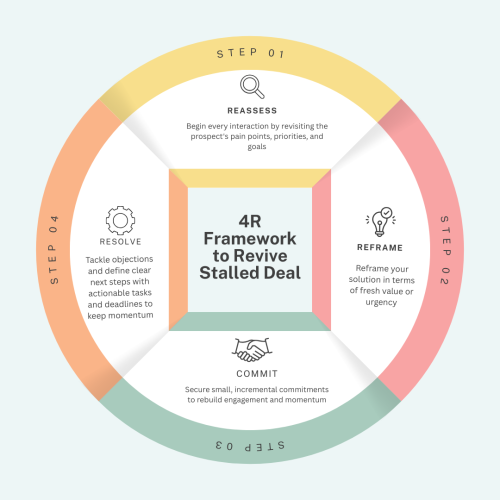
A. 4 R's Deal Acceleration Framework
Reassess
Begin every interaction by revisiting the prospect’s pain points, priorities, and goals. This ensures alignment and demonstrates that you’re focused on their evolving needs.
Example: “Since we last spoke, has anything changed in your priorities or challenges that we should address?”
Reframe
Shift the conversation to highlight new opportunities or perspectives that reignite interest. Reframe your solution in terms of fresh value or urgency.
Example: “Given the recent [industry trend], this solution could help you stay ahead by [specific benefit].”
Recommit
Secure small, incremental commitments to rebuild engagement and momentum. These micro-commitments can be as simple as agreeing to a follow-up meeting or reviewing a proposal together.
Example: “Would you be open to a quick walkthrough of the ROI analysis next week?”
Resolve
Address objections head-on and provide clear next steps to eliminate ambiguity. Ensure both parties leave with actionable tasks and deadlines to maintain progress.
Example: “If we resolve [specific concern], can we move forward with the implementation timeline we discussed?”
Why the 4 R’s Work:
Reassess ensures relevance by focusing on updated needs.
Reframe creates renewed interest by introducing fresh perspectives.
Recommit builds momentum through small wins.
Resolve eliminates barriers and keeps deals moving.
This framework is designed for modern sales environments where prospects are more informed, decision cycles are longer, and personalization is critical. It prioritizes customer-centricity while systematically addressing common causes of stalled deals.
B. Leverage Multithreading to Engage Multiple Stakeholders Simultaneously
One of the most effective ways to accelerate stalled deals is by adopting a multithreading This strategy involves engaging multiple stakeholders within the prospect’s organization rather than relying on a single point of contact. By building relationships across different departments and levels of influence, you can reduce the risk of delays caused by internal bottlenecks or decision-maker unavailability.
Map the Organization: Identify all key stakeholders involved in the buying decision, including decision-makers, influencers, and end-users.
Tailor Messaging: Customize your communication for each stakeholder based on their role, priorities, and concerns.
Leverage Internal Champions: Use existing relationships to gain introductions to other stakeholders.
Collaborative Engagement: Schedule multi-stakeholder meetings where possible to align priorities and accelerate consensus.
Why It Works: Multithreading ensures that your deal doesn’t stall due to a single stakeholder losing interest or leaving the organization. Research shows that B2B buying decisions often involve 6-10 stakeholders, and engaging multiple individuals increases your chances of maintaining momentum and closing the deal.
KPIs to Measure Success in Stalled Deal Acceleration
To evaluate the effectiveness of your stalled deal acceleration efforts, track these key performance indicators:
1.Revival Rate
Calculate the percentage of stalled deals that return to active status after intervention:
Revival Rate = (Number of Reactivated Deals ÷ Total Stalled Deals) × 100
Benchmark: Top-performing sales organizations achieve revival rates of 35-40% for deals stalled less than 60 days.
2.Time to Reactivation
Measure how quickly your interventions restore momentum:
Time to Reactivation = Average Days Between Identifying Stall and Meaningful Reengagement
Benchmark: Aim to reduce this metric to under 14 days for optimal results.
3.Post-Revival Velocity
Track how quickly revived deals progress compared to never-stalled opportunities:
Post-Revival Velocity = Average Days to Close for Reactivated Deals ÷ Average Days to Close for Normal Deals
Benchmark: A ratio under 1.5 indicates successful reactivation; higher ratios suggest lingering issues.
4.Conversion Rate of Revived Deals
Monitor the percentage of reactivated deals that ultimately close:
Conversion Rate = (Number of Closed-Won Reactivated Deals ÷ Total Reactivated Deals) × 100
Benchmark: Expect 5-10% lower conversion rates for reactivated deals compared to never-stalled opportunities
Conclusion
Stalled deals represent both a challenge and an opportunity for sales organizations. By implementing systematic identification methods, understanding the root causes of stalls, and applying targeted acceleration strategies, sales leaders can significantly improve pipeline velocity and close rates.
Remember that stalled deals provide valuable intelligence about your sales process, messaging effectiveness, and prospect engagement strategies. Use these insights to continuously refine your approach and prevent future deals from stalling in the first place.
The most successful sales organizations don’t just revive stalled deals, they build systems that minimize the likelihood of stalls occurring. By focusing on the right KPIs, implementing proven acceleration techniques, and fostering a culture of relentless but thoughtful follow-through, you can transform stalled deals from pipeline problems into revenue opportunities.
Ready to revive stalled deals and equip your team with a powerful sales playbook?
Let us help you reengage prospects, accelerate deal velocity, and create a tailored sales playbook that drives consistent success.
Don’t let stalled opportunities block your revenue goals.
He is a seasoned sales professional with 14+ years of quota-crushing and Sales Strategy expertise in North America and Asia. His specialization lies in crafting innovative strategies for New Business Development and maximizing returns from existing accounts.